Open source · built in public
Verified agent-system generation
Describe a problem. The factory interviews you, designs a small AI agent system for it, and has to prove it with evaluations before it goes live. A human approves every step that matters.
The problem
"It seems to work" is not an acceptance criterion
Most agent demos stop when the output looks reasonable. Nobody measures whether the reviewer agent catches real problems, invents problems that aren't there, or quietly softens what it finds. This project treats that as the main question, not an afterthought.
Small by design
As few agents as the problem needs, on fixed routes with hard limits on loops, calls and tokens. Sometimes the right answer is a script.
Measured, not assumed
Reviewer agents are calibrated against planted defects and near-miss clean cases. A weaker model must score lower on the same suite.
Human-approved
Every gate is a decision made in the owner's own terminal. An approval is bound to the exact files approved; change one character and it's void.
How it works
From a short brief to a proven system
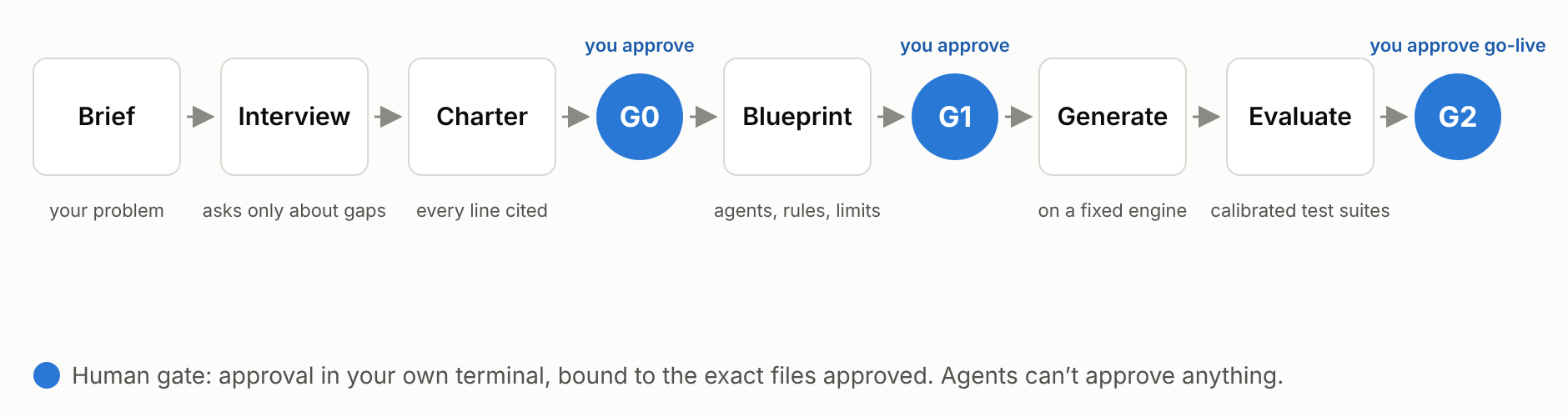
Four stages, three human gates. Agents do the work; only a person can approve it.
Interview
You fill a short brief. An interviewer agent asks only about what's missing, vague or contradictory.
Charter G0
Your answers become a structured problem statement. Every line cites the answer or file it came from.
Blueprint G1
The charter becomes a design: which agents, which rules, which gates and limits, each one justified.
Generate and prove G2
The system is generated on a fixed, tested engine, then has to pass its evaluation suites before go-live.
What's proven so far
The first real job, end to end
A generated two-agent system turned meeting notes into an action list: a writer lists each action with its owner, due date and source sentence; a critic checks the list against the rules.
The failed evaluation was the most useful result
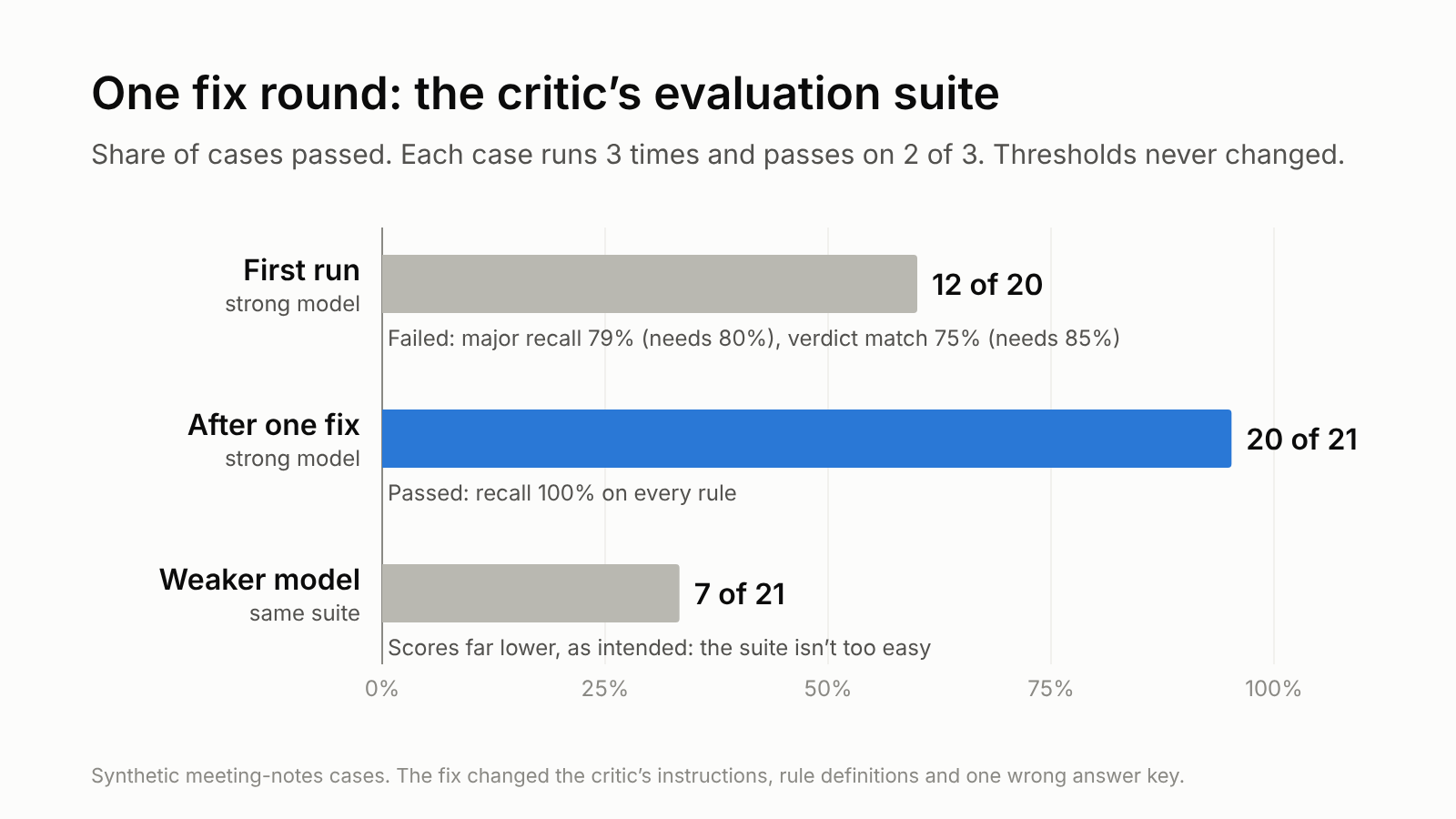
The first evaluation run failed: in some runs the critic softened major problems into minor ones, and the writer listed a conditional plan ("if the café says no…") as an action. One fix round later, both suites passed with their thresholds unchanged, and a weaker model still scored far lower, which shows the tests aren't too easy.
Synthetic test data throughout. Figures from the project's build log.
Lessons
Five lessons that carry to any agent project
Each one came from something that broke. The full list is in the repository's lessons file.
- An unreadable file is not an empty file.A settings file with a missing comma was read as "no settings" and passed the check. Now "can't read it" is always a failure.
- Evaluate the prompt the job will actually send.Evaluations passed while the real job's reviewer had no rulebook. Jobs and evaluations now share one prompt builder, compared word for word by a test.
- A tool's promise is only as good as the tool.An agent declared with no tools still received tools on one platform version. Agents now run sealed, and the setting is re-checked on every update.
- When a test fails, check the answer key before the agent.Several "failures" were wrong expected answers. Each failing case is now judged on its own merits before anything changes.
- A check that looked at nothing is not a pass.A publishing check reported "clean" after scanning zero files. Every pass must now say how much it examined, and a metric that can't be computed fails.
Status
Where the build stands
Built phase by phase; a phase only counts once its exit criteria are approved. Full plan in the roadmap.
How it's built
A product manager, Claude Code, and a strict process
The author is a product manager who doesn't write code. Claude Code wrote and tested every line; the author specified, reviewed and decided, with a second Claude conversation reviewing every plan and result before approval.
The working rules
- Every task: a plan, a check that must pass, one commit, one log row
- Wrong agent output is never fixed by hand; the agent or its rules change
- No threshold is ever lowered to make a test pass
- Synthetic or public data only; nothing from anyone's work
- Every push passes a publish check for secrets and personal data
Scope
What this is, and what it isn't
It is
- A factory for small, purpose-built agent systems for one owner
- Local, single user, on a Claude subscription
- Evaluation-first: nothing goes live unproven
It isn't
- A multi-repository code generator or dependency-graph tool
- A general agent swarm or orchestration framework
- A hosted, concurrent or enterprise-compliance service
Updates
Follow the build
An update at each milestone, with the numbers and with what broke.
Part 1: An agent factory that doesn't trust its own agents
The first real run, the evaluation that failed, and five lessons. Link coming soon.
Next: the first charter from a live interview
Coming at the end of Phase 2.
Discussions
Questions, ideas, and how you measure your own agents.